NVIDIA Omniverse 'simulation-first' era in manufacturing: ABB Robotics 99% sim-to-real accuracy, JLR compresses aerodynamic simulation from 4 hours to 1 minute
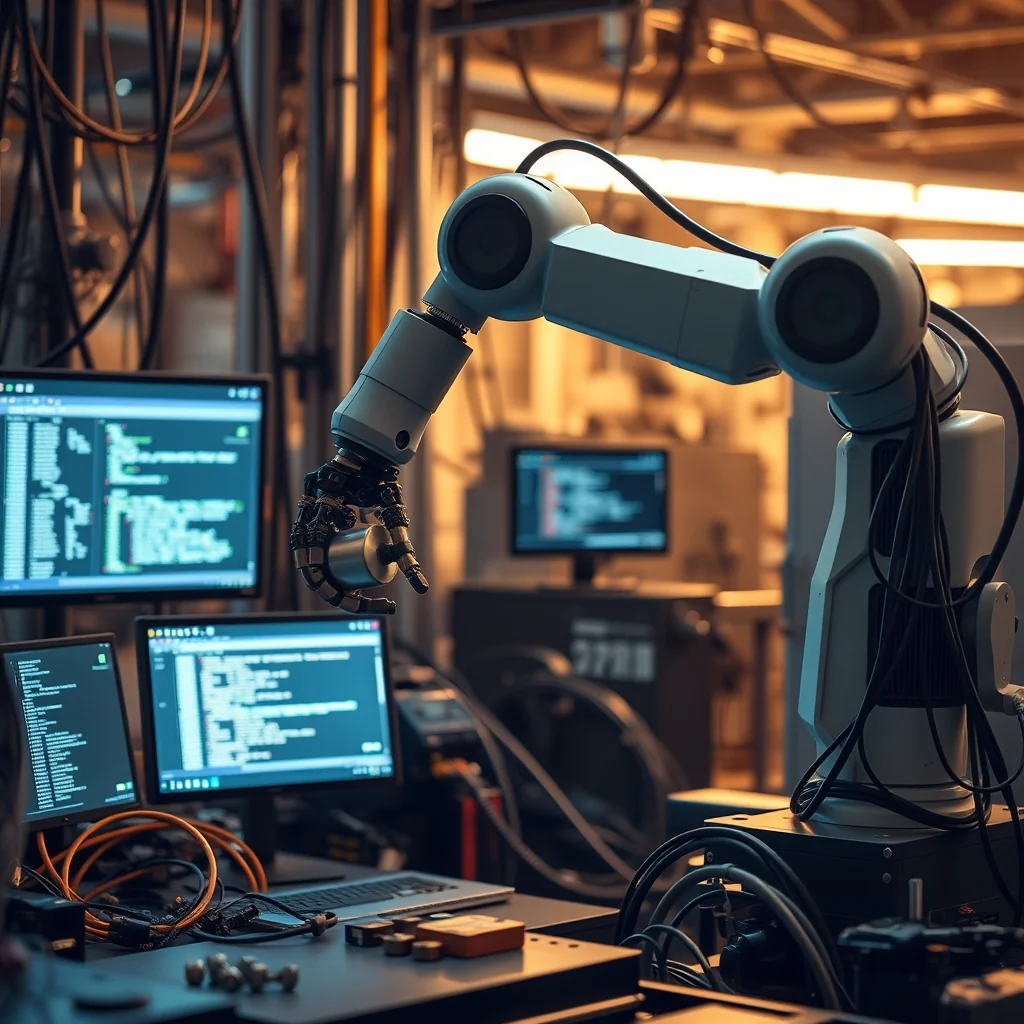
NVIDIA's new Omniverse post presents concrete metrics from industrial deployments: ABB Robotics achieves 99% sim-to-real accuracy and reduces product introduction cycles by up to 50%, JLR compresses aerodynamic simulation from four hours to one minute using neural surrogate models trained on 20,000 CFD simulations, and Tulip's Factory Playback platform at Terex expects a 3% yield increase and 10% reduction in rework. The entire architecture rests on OpenUSD and the SimReady standard as a common format for physically accurate 3D assets.
This article was generated using artificial intelligence from primary sources.
On April 28, 2026, NVIDIA published an Omniverse post on the “simulation-first” era in manufacturing — an approach in which AI models and robotic systems are trained in high-fidelity simulation before production deployment. The post offers concrete metrics from four major industrial partnerships.
Technical foundation: SimReady on OpenUSD
OpenUSD is the connective standard enabling portability of 3D assets between design, simulation, and AI training. SimReady, built on OpenUSD, defines what a physically accurate 3D asset must contain in order to reliably work across rendering, simulation, and AI training pipelines. NVIDIA Omniverse libraries provide a physics-accurate, photorealistic simulation layer.
ABB Robotics: 99% sim-to-real accuracy
Quote from Craig McDonnell (managing director): “We have vertically integrated the complete technology stack and optimized it to the point where we now achieve 99% accuracy on the simulated version.” The RobotStudio HyperReality platform is used by 60,000+ engineers globally. Concrete savings:
- Up to 50% reduction in product introduction cycles
- Up to 80% reduction in commissioning time
- 30–40% reduction in overall equipment lifecycle cost
JLR: 4 hours → 1 minute
Jaguar Land Rover compresses aerodynamic simulation from four hours to one minute through the Neural Concept Design Lab, built on Omniverse. Neural surrogate models are trained on 20,000 wind-tunnel-correlated CFD simulations — meaning predictions are based on empirical data, not purely on simulation. 95% of aero-thermal workloads run on NVIDIA GPUs.
Terex (Tulip Factory Playback)
Terex (40+ factories globally) has deployed Tulip’s Factory Playback platform, which uses the NVIDIA Metropolis VSS Blueprint and NVIDIA Cosmos vision language models for real-time factory intelligence extraction from cameras and sensor data. Expected savings: 3% yield increase and 10% reduction in rework.
The bigger picture
The pattern that repeats across all three customer case studies: empirically validated neural surrogate models + high simulation fidelity + standardized asset format = measurable savings in weeks/months of product development. Manufacturing AI is moving out of the “demo phase” into an operational phase with concrete ROI numbers.
Frequently Asked Questions
- What is the SimReady standard?
- SimReady is a content standard built on OpenUSD that defines what physically accurate 3D assets must contain in order to reliably work across rendering, simulation, and AI training pipelines. OpenUSD is the connective standard enabling asset portability between 3D design, simulation, and AI.
- How does JLR compress simulation from 4 hours to 1 minute?
- The Neural Concept Design Lab (built on Omniverse) uses neural surrogate models trained on 20,000 wind-tunnel-correlated CFD simulations. Engineers get real-time visualization of aerodynamic changes instead of waiting for a full CFD pass. 95% of aero-thermal workloads run on NVIDIA GPUs.
Related news
arXiv:2605.22681: CUSP benchmark shows frontier models cannot reliably predict scientific breakthroughs
arXiv:2605.22337: Meta-Soft introduces KV cache compression via composable meta-tokens and learnable orthogonal bases
arXiv:2605.22664: WorkstreamBench tests LLM agents on end-to-end spreadsheet tasks in finance — and frontier models fail